post

Eight Days a Week


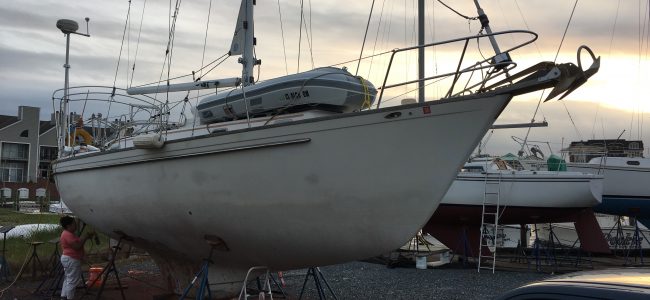
We hauled out our sailboat eight days ago just in case hurricane Florence came our way.

We’re living in a dirty boat yard while doing back- breaking labor. Not what I pictured retirement to be.

When we hauled out, huge flakes of bottom paint ( for which we had paid a lot of money a year ago) came sloughing off s/v Laura Jack. Rut-roh. Time for a full bottom job.

Bottom paint is a toxic mess designed to keep sea critters from growing on your hull. But it only lasts a year or so. Then you have to put a fresh toxic layer of $250-gallon paint on her. But eventually you have to sand it all off and start over. That’s where we are now.

It’s been eight days of hell so far. And no end in sight.

We’ve got about two-thirds of the bottom scraped and we’re sanding away. We pulled the prop shaft with much difficulty, and $400 later we have a new stuffing box and a straightened shaft. ( A stuffing box is not something from Harry Potter’s gag shop, but rather the thing that keeps water out around the drive shaft. Kinda important, the stuffing box is.)

We’re doing the work ourselves. Thirty years ago, I swore I’d never do another bottom job. But current labor prices have changed my mind. It would take $1150 a day over a week or more to have it done. So we’re doing it ourselves.

A fine red dust follows us everywhere despite efforts to contain it. Living in a boat yard is kind of like living in a truck stop, with all the associated dirt, noise, and testosterone to go with it. Tempers are getting short.

Can’t wait to get back in the water.

A Floating Tiny Home

S/V Laura Jack is 36 feet long. She (all boats are “she”) has been our home for the past year.

She’s around 40 years old and still kicks up her heels now and then. A Pearson 365 sloop she is. If you’re not a sailor, the only thing you need to know is that she’s middling size for a sailboat but really small by tiny house standards.

We sailed her down to the Chesapeake from Long Island Sound, going past Manhattan on the East River during morning rush hour to catch slack tide at Hell Gate. A long overnight sail under a magical full moon off the New Jersey coast brought us to the Delaware Bay and its biting flies and then we went on through a shipping canal to the upper Chesapeake.

We’re sort of green aboard. We have solar panels for electricity and a composting toilet for the head. Our diesel engine sips fuel when we’re not sailing. (Sailing’s dirty secret: you spend more time motoring than sailing if you have somewhere to actually go.)

My wife and I have come to terms with the tiny space. One of us must stand out of the way in one of the two small wider spaces aboard if the other needs to move forward or aft. (Front or back for you dirt dwellers.)

Our boat has a v-berth in front, which has a luxurious king-size space where our pillows go, but the space for both our feet is about the size of the footwell in a Honda Civic. Getting in and out of bed involves a step stool and some yoga moves, because there’s not much headroom. No sheets on earth fit this odd-size layout, so making the bed involves a lot of grunting while trying to tuck in the excess with one’s head up against the anchor locker.

The bathroom (“head” in boat language,) is almost big enough to turn around in, and there’s even a shower in there, (which isn’t big enough to turn around in.) A composting toilet is a huge improvement over a traditional marine head and holding tank. Holding tanks get filled in three days and the few pumpout stations in any given area are usually broken or blocked by some cigar-smoking a-hole in a phallic-compensating go-fast boat. If functioning, it costs five dollars for you to grab a disgusting dripping poo hose and stick it in a small opening sealed with a cap (that never wants to open when you need it,) in order to slurp out your sewage from the past three taco meals. Oh did I mention the ever-present sewage odor inside your boat?

A composting toilet, on the other hand, doesn’t smell because it separates the pee from the poo. The coconut coir composting medium has an earthy smell but it’s almost pleasant compared to a holding tank. Of course you have to empty your pee bottle frequently, but the compost can last three weeks or so before getting dumped into a contractor trash bag and disposed of with all the kiddies’ dirty diapers in the nearest dumpster.

Off the grid. That’s us. Well, unless we’re plugged into a marina to get some cool air from an energy-sucking portable air conditioner in the summer. So much for green intentions!